
I Requested Agencies' Ten Oldest Open FOIA Requests
Being the change you wish to see in the world

I will preface the newsletter by saying that as a metric the ten oldest outstanding open requests are not useful. However, I also acknowledge that they are routinely used as a metric to evaluate the health of agencies’ FOIA Programs.
Years ago I worked to support the FAA’s Air Safety’s FOIA Program. Since I do not have their oldest requests in front of me I don’t want to say a blanket statement, but I recall that our oldest requests were old for very unusual reasons.
In one instance we had completed the vast majority of a particular request. We had produced thousands of documents. We had given the requestor those documents in installments (“interim responses”). The requestor had moved on with their life but had not withdrawn the request. The remaining records were not FAA records. The records were the creation of other air authorities. Those authorities hardly understood FOIA. Every five to six months someone from Air Safety pinged (I’m making up an agency) the Civil Aviation Authority of Fiji to get CAAF to get their feedback about CAAF records Air Safety possessed. CAAF would either not respond, or say they were working on it, or that they had never heard of the request before.
The fact the request was still open didn’t speak to our process’s strengths, and it also didn’t speak to the weaknesses. If a well-meaning reformer reviewed Air Safety’s oldest requests, they would likely notice a pattern of poor coordination with international air authorities. However, as the DOT’s FOIA Officer observed, the real obstacle to getting requestors their documents from the Department of Transportation and its component agencies like the FAA is less exciting than aligning Fiji’s CAAF.
The problem with the DOT’s FOIA system is that the resources are not there for a system that responds to that many requests. Even documents fully owned by components are backlogged because it’s one step forward two steps back.
But I’m still curious. So I filed several FOIA Requests for different agencies’ ten oldest requests.
Background
On the face of the statute, FOIA says that government agencies must process and respond to requests within 20 days, with a possible 10-day extension to accommodate “unusual circumstances.” FOIA also permits agencies to “toll” the time needed to respond to a request one time for clarification and as many times as needed for fee questions. (552(a)(6)(A)(ii)).
Of course, very few requests do get resolved in twenty, thirty or even forty days.
The penalty that agencies experience for failing to follow the twenty-day framework is agencies cannot generally assess search and/or duplication fees. However, the penalty is not universal. The request could otherwise fall under one of the cost exceptions that would allow an agency to collect fees—which is a topic that will be its own newsletter one day.
In other words, there’s not a ton that forces agencies to respond unless they are seriously threatened with litigation.
The Department of Justice first asked agencies to report their ten oldest pending requests in their Annual FOIA Reports in Fiscal Year 2007.1 In Fiscal Year 2008, pursuant to the Open Government Act of 2007, Congress codified the requirement for agencies to report the ten oldest requests in the expanded list of data that is required to be reported in Annual FOIA Reports. The revised statutory requirements also obligate agencies to report how long their ten oldest requests have been pending. In 2011, OIP included the closing of the ten oldest requests as one of its evaluation criteria in its assessment of the cabinet agencies' progress in implementing the Attorney General’s FOIA Guidelines.2
For additional context, there is an interplay of two connected issues: requests and consultations. Like above with Fiji, when agencies process records in response to a FOIA request, they often locate records in which another agency or component has an interest. When these records originated with the agency in receipt of the request, that agency generally remains responsible for the final response, but the receiving agency typically must consult with the agency or component with equity in the document prior to making a disclosure determination. Delays in receiving a response on the consultation necessarily also delays the final response to the requester.
Because of that linkage, the DOJ also requests the number of consultations that are pending at every agency and the ten oldest such pending consultations. In OIP's assessment of agency progress in implementing the Attorney General's FOIA Guidelines, one of the criteria for assessing agencies is whether they closed their ten oldest pending consultations.
Importantly, I’m also asking for agencies’ ten oldest consultations to help better understand how that consultation process looks when the consultation process gets backlogged. Ideally, it’ll be a little like double-dipping in the sense I am asking for the text of the underlying request a requestor sent to the initial agency before it was sent to the agency I’m requesting consultation records from.
Selecting the Agencies
Long ago, the Knight Foundation used to do the same thing I am doing now. As far as I know, the Foundation would provide Knight Surveys to the public. The surveys were yearly reports on their outstanding ‘requests for requests.’ They were in the business of requesting and reporting on agencies’ oldest active FOIA requests, which occasionally meant reporting on just how long the agencies were taking to respond to the Knight’s own FOIA requests. The (often staggering) age of agencies’ oldest requests became a key metric the Archive used to examine FOIA statistics.
Like mentioned above, the “Ten Oldest” request metric was adopted by George W. Bush’s Executive Order on FOIA and codified by the OPEN Government Act of 2007 when the Washington Post, New York Times, and the Chicago Sun all ran stories using the report as proof that the FOIA process was broken. Each agency is required by law to report its ten oldest requests in its annual FOIA report. However, that’s not the same as seeing what they actually are.
After 2007, the Knight Foundation continued to be involved in FOIA discussions, and they found marooned FOIA requests – some as old as 18 years. What was common were 12 key agencies – including the National Archives, the Central Intelligence Agency, Department of Defense, Department of Justice, and Department of State – who all had requests older than six years.
Unfortunately, I’m not sure what ever happened to the people who did the FOIA stuff for the Knight Foundation. The Foundation still exists, but apart from a FOIA Machine Kickstarter I don’t think I’ve heard much from them. Of course, I’d love to be proven wrong! If anyone knows what their current FOIA advocacy looks like I’d enjoy reading up on it.
Here is a screenshot of their 2011 audit. For ease, I’m picking the same agencies.

I briefly considered a few other agencies, especially smaller random ones, but what I realized is that the smaller ones do not have much rhyme or reason to their FOIA burdens. For example, the Commodities Futures Trading Committee. They just don’t get FOIAs.
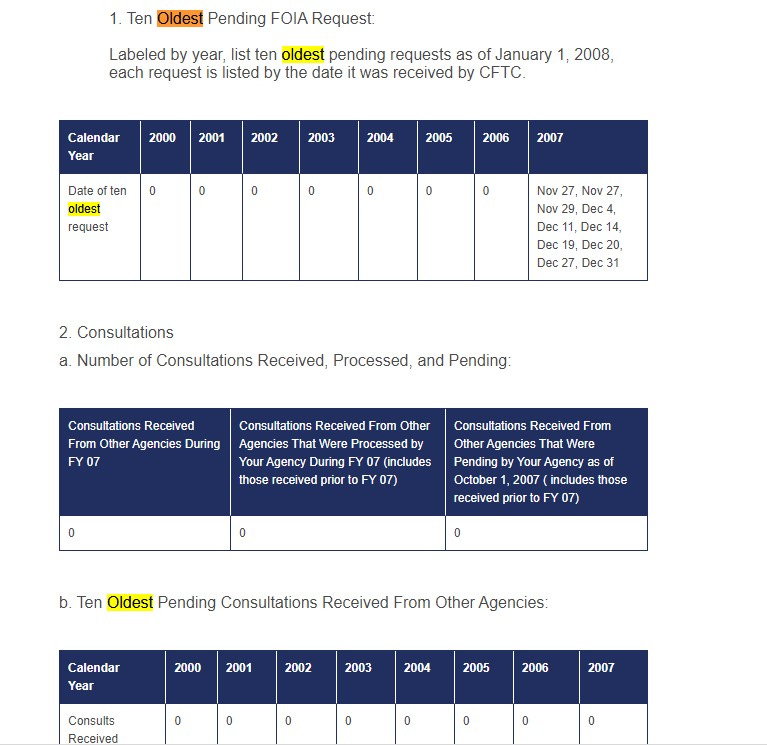
My expectations for this are fairly low. For example, I did do some research on MuckRock, which is a sort of social media meets public record request site that allows multiple people to file multiple requests, and then lets even more people follow up on the request when the first requestor gets bored.
Years ago I found that someone FOIA’d the 5 oldest requests from the USMC, DCMA, Air Force, Army, Defense Commissary Agency and several others. The completed responses took over a year. In a way this is helping out future myself if I am still running this blog because in a year I will be desperate for content.
Language of the Request
I am not trying to reinvent the wheel. The language I am using follows,
To Whom It May Concern,
This letter constitutes a request pursuant to the Freedom of Information Act ("FOIA"), 5 U.S.C. § 552 et seq., and its implementing regulations.
I seek the records referencing the ten oldest FOIA requests and the ten oldest FOIA consultations that are still being processed.
As part of my request, I am also requesting documentation made by your personnel or contractors about the processing of these ten oldest requests and ten oldest consultations. This is to include any analysts' notes made during the processing of the requests, any standard worksheets completed by the analysts, any justifications for exemption invocations or other supporting documentation provided to the Appeals Authority, and any correspondence referencing the requests, including tasking orders, emails, and coordination documentation.
Additionally, please provide the initial request letters for the ten oldest open FOIA requests, and the cover letters (if applicable) of the ten oldest consultation requests.
When processing this request, please note that the D.C. Circuit has previously held that agencies have a duty to construe the subject material of FOIA requests liberally to ensure responsive records are not overlooked. See Nation Magazine, Washington Bureau v. U.S. Customs Service, 71 F.3d 885, 890 (D.C. Cir. 1995). Accordingly, you are hereby instructed that the term “record” includes, but is not limited to: 1) all email communications to or from any individual within your agency; 2) memoranda; 3) inter-agency communications; 4) sound recordings; 5) tape recordings; 6) video or film recordings; 7) photographs; 8) notes; 9) notebooks; 10) indices; 11) jottings; 12) message slips; 13) letters or correspondence; 14) telexes; 15) telegrams; 16) facsimile transmissions; 17) statements; 18) policies; 19) manuals or binders; 20) books; 21) handbooks; 22) business records; 23) personnel records; 24) ledgers; 25) notices; 26) warnings; 27) affidavits; 28) declarations under penalty of perjury; 29) unsworn statements; 30) reports; 31) diaries; or 32) calendars, regardless of whether they are handwritten, printed, typed, mechanically or electronically recorded or reproduced on any medium capable of conveying an image, such as paper, CDs, DVDs, or diskettes.
I also request that, if appropriate, fees be waived as this request is in the public interest and not for a commercial purpose.
In the event that fees cannot be waived, I preapprove processing charges in the amount of 100$.
If the amount exceeds 100$, please inform me of the total charges in advance of fulfilling my request. I would prefer the request filled electronically by e-mail attachment if available.
Thank you in advance for your anticipated cooperation in this matter. I look forward to receiving your response to this request within 20 business days, as the statute requires.
Sincerely,
Max Eichelberger
And that’s that! In the future I’ll keep everyone updated on how things are going, what sort of responses I get, and what my responses back are.
The FOIA Guidelines noe that the "[t]imely disclosure of information is an essential component of transparency," and "[l]ong delays should not be viewed as an inevitable and insurmountable consequence of high demand."
Looking forward to the update on what you have received after 20 days. It's only a summary of stuff they have outstanding so it shouldn't be too difficult for them to drag together. Great letter.
I lend you the fortitude necessary to bug the 💩 out of each agency until your request is honored!